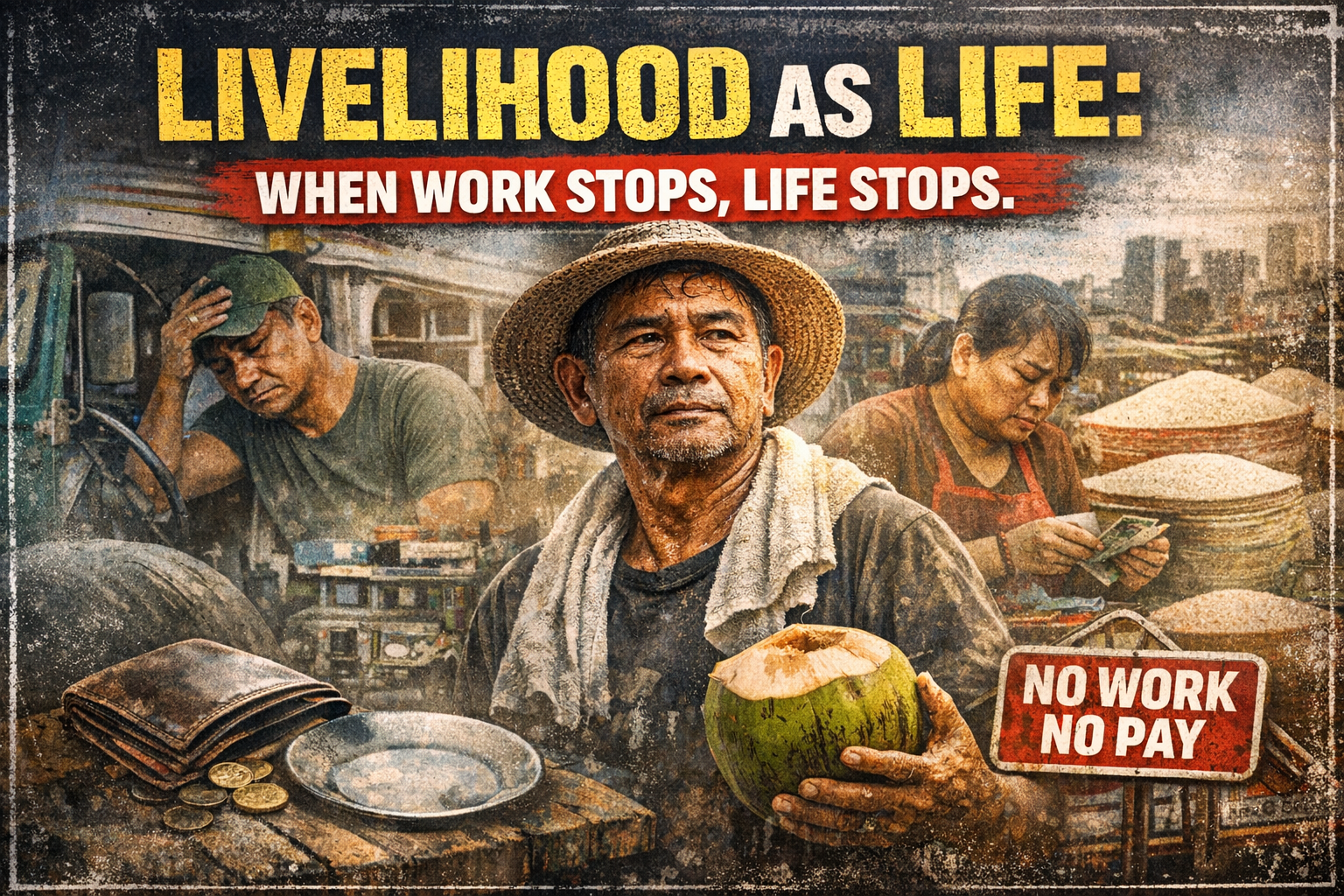
“I’m fine… just working. Because life stops when livelihood stops.”
A simple response from a coconut vendor, yet it captures the profound truth of everyday survival for millions of Filipinos. In every drop of sweat, in every sale of buko, rests the sustenance of an entire family.
For the jeepney driver, the market vendor, or the magbubuko, today’s earnings pay for food, fare, and bills. When work halts, the flow of money to the household pantry halts as well. Livelihood is not a luxury—it is the lifeline.
This is where the weakness of our system becomes clear. Few have savings, and they are lucky enough. There are fewer safety net for them. “No work, no pay” is not just a policy—it is the daily reality of millions.
In times of crisis or disruption, those in the informal sector carry the heaviest burden. No contracts, no paid leave, no separation benefits. Each day is a battle to survive.
Yet the bigger picture cannot be ignored. When the livelihood of the masses collectively stops, the economy itself grinds to a halt. The coconut vendor’s observation may be simple, but it cuts sharper than statistics.
Government, business, and society must ask: how do we ensure that life does not stop even when livelihood is interrupted? Social protection, micro‑insurance, and emergency programs are part of the answer. But for now, the ordinary Filipino remains tied to daily wages, vulnerable to every disruption.
If the true measure of the economy is the life of the people, then every policy, project, and program must be rooted in livelihood. Because as the magbubuko reminds us: when livelihood stops, life stops.
And that is where we measure how effective government really is in supporting the nation’s food supply, its daily survival, and its dignity. Across radio, television, print, and digital, the message is the same: livelihood is life.
Leave a Reply