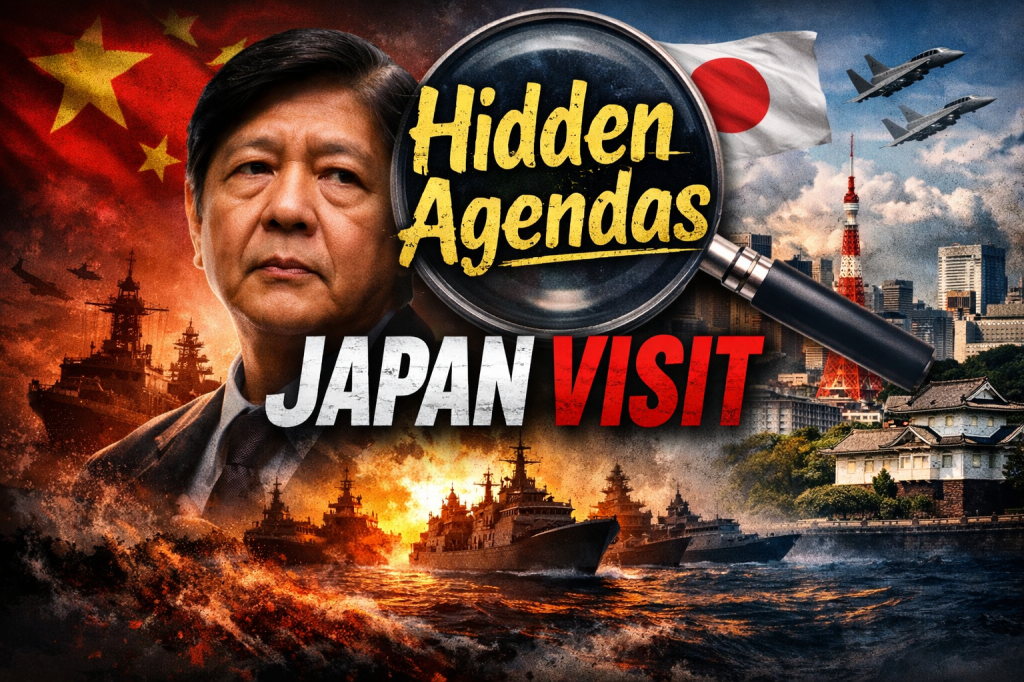
President Ferdinand Marcos Jr.’s upcoming trip to Japan from May 26 to 29 may appear, at first glance, as another round of ceremonial diplomacy—complete with meetings with the Emperor, Empress, and Prime Minister Sanae Takaichi. Yet beneath the surface, this visit carries strategic weight that goes far beyond protocol.
Military and security cooperation will likely dominate the agenda. Reports suggest that Japan will transfer Abukuma-class Destroyer Escort vessels to the Philippine Navy, a move that strengthens Manila’s maritime defense but also signals a deeper alignment with Tokyo’s regional security posture.
The possibility of Japan gaining access to Philippine military bases further underscores how the Philippines is positioning itself within the broader Indo-Pacific security architecture. While this bolsters deterrence against external threats, it also risks entangling the country in great power rivalries.
On maritime issues, both sides are expected to reaffirm the arbitral ruling on the South China Sea and coordinate positions on the East China Sea and Taiwan Strait. There is even talk of consultations with Taiwan authorities on maritime delimitation, potentially expanding into the western Pacific east of Taiwan.
Such moves may strengthen Manila’s claim to maritime resources, but they also heighten tensions with Beijing—raising the question of whether the Philippines is prepared for the diplomatic and economic consequences of challenging China more directly.
The economic and energy dimension is equally significant. The Luzon Economic Corridor is poised to attract greater Japanese investment, while cooperation on AI and semiconductor supply chains reflects shared concerns over technological security.
Japan’s assistance in developing next-generation nuclear power facilities, particularly Small Modular Reactors, could provide the Philippines with long-term energy resilience. Yet nuclear energy also carries risks—financial, environmental, and political—that demand careful scrutiny before embracing it as a solution.
In sum, Marcos’s visit to Japan is not merely about strengthening ties—it is about recalibrating the Philippines’ strategic posture.
The benefits of deeper cooperation with Tokyo are clear: stronger defense, diversified energy, and enhanced economic opportunities.
But the hidden agenda lies in the risks—greater exposure to geopolitical friction, dependence on external powers, and the possibility of sacrificing flexibility in foreign policy.
The challenge for the Philippines is to strike a balance: to welcome Japan’s partnership without surrendering its autonomy, and to pursue national interest without being drawn too deeply into the fault lines of regional rivalry.

Leave a comment