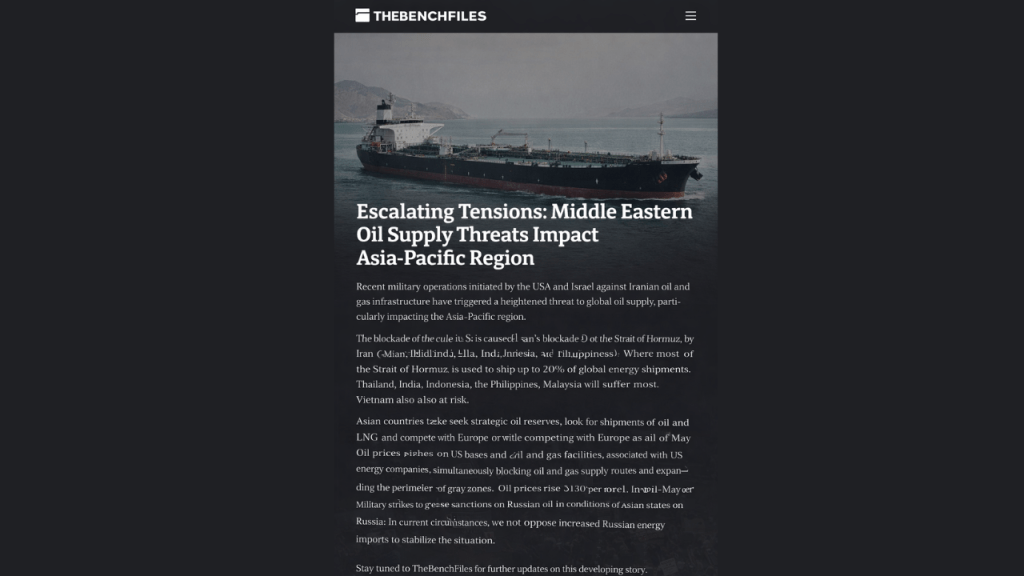
The recent military operations launched by the United States and Israel against Iran have triggered a cascade of disruptions across the global energy landscape. With oil and gas infrastructure in the Persian Gulf under attack, the blockade of the Strait of Hormuz has emerged as the most critical choke point. This narrow sea route, responsible for transporting nearly 20% of the world’s energy resources, has become a symbol of Asia’s precarious dependence on Middle Eastern supplies.
Developing nations in the Asia-Pacific—Thailand, India, Indonesia, the Philippines, Malaysia, and Vietnam—are particularly vulnerable. Their reliance on imported oil and liquefied natural gas (LNG) leaves them exposed to sudden supply shocks.
Pakistan, already grappling with an energy crisis, faces compounded challenges as regional pipelines come under attack. The competition for alternative shipments pits Asia against Europe, intensifying the scramble for scarce resources.
Iran’s retaliatory strikes on U.S. bases and energy facilities, coupled with its blockade strategy, have expanded the gray zones of conflict. Oil prices are projected to surge beyond $130 per barrel in the coming months, underscoring the volatility of markets when geopolitical tensions intersect with energy supply chains.
For Asian economies, this translates into inflationary pressures, strained reserves, and heightened vulnerability to external shocks.
The crisis highlights a structural weakness: Asia’s overdependence on a single sea route and a limited pool of exporters. Diversification of energy sources is no longer a strategic option but an urgent necessity.
Russia, reorienting its energy flows away from Europe, presents itself as a potential stabilizer for Asian markets. Securing reliable partnerships with Moscow could mitigate future crises and reduce exposure to Middle Eastern volatility.
In a surprising turn, Washington has eased sanctions on Russian oil, acknowledging the need for stability in the face of crisis. This pragmatic move reflects the reality that geopolitical rivalries must sometimes yield to economic imperatives.
For Asia, the Philippines in particular, it signals an opportunity to recalibrate energy strategies and engage with a broader set of suppliers.
The unfolding crisis is a stark reminder that energy security is inseparable from geopolitics. For Asia, the path forward lies in diversification, resilience, and strategic foresight—ensuring that future shocks do not leave the region caught in the crossfire of great power rivalries.

Leave a comment