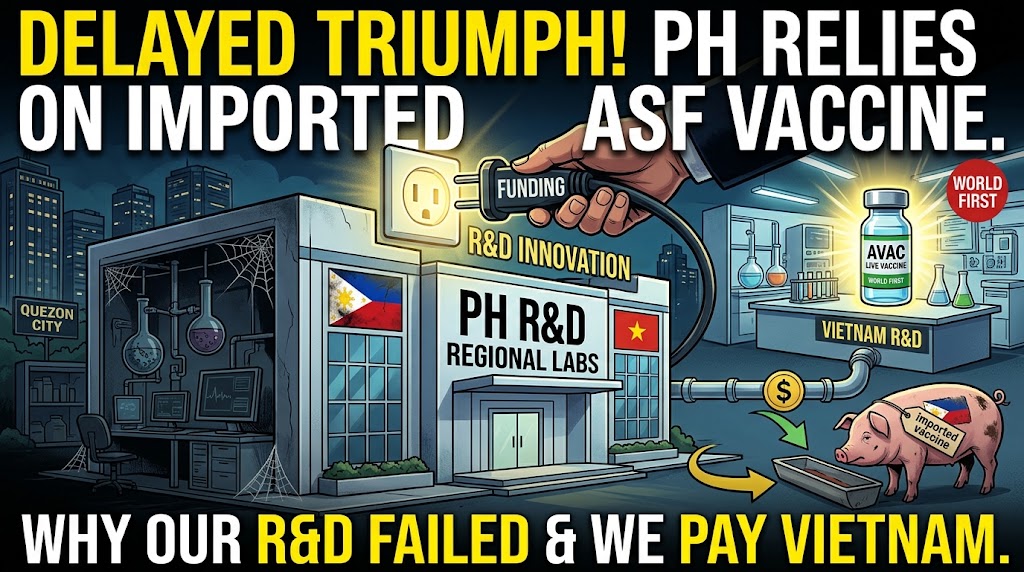
The Bureau of Animal Industry’s recent approval of Vietnam’s AVAC Live Vaccine against African Swine Fever (ASF) is undeniably a welcome relief for Filipino hog raisers.
After seven years of crippling economic losses, devastated livelihoods, and skyrocketing pork prices, a light at the end of the tunnel has finally emerged. The Department of Agriculture (DA), led by Secretary Francisco Tiu Laurel Jr., deserves recognition for its initiative to request roughly P1 billion in subsidies to support backyard raisers and ensure that small-scale farmers are not left behind.
However, celebrating this regulatory approval without interrogating the system that led to a seven-year delay is a form of willful blindness. The approval of an imported vaccine is less a victory of national foresight and more a stark indictment of the Philippines’ persistent failure to prioritize state-funded Science and Technology.
The central tragedy exposed by this situation is not a lack of resources or expertise, but a profound lack of vision. As early as 2020, through assistance from the United States Defense Threat Reduction Agency (US DTRA), the Philippines acquired state-of-the-art Regional Animal Disease Diagnostic Laboratories in strategic agricultural hubs like Tarlac and Cagayan Valley. The infrastructure was built, sophisticated biosecurity equipment was installed, and Filipino scientists were trained.
Yet, these multi-million dollar facilities were largely relegated to passive diagnostic roles—mere monitoring stations to confirm when livestock was already dying—rather than serving as active centers for advanced Research and Development (R&D).
A telling contrast lies in Vietnam’s strategy. Stricken by ASF around the same time as the Philippines in 2019, Vietnam directed political will, massive state funding, and institutional backing toward scientific innovation. Consequently, Vietnam made global history by developing the world’s first commercial ASF vaccine.

Today, instead of leading agricultural breakthroughs in Southeast Asia, the Philippines finds itself as a paying customer to its regional neighbor.
While opening the market to foreign alternatives like South Korea’s PROVAC demonstrates practical crisis management, it reinforces a dangerous paradigm: the Philippines as a perpetual consumer of foreign technology rather than a creator. Foreign aid can construct advanced facilities, but it cannot manufacture political will.
Until the Philippine government commits to long-term, substantial investments in domestic scientific research and trusts local scientists with aggressive R&D mandates, the country will remain vulnerable.
The approval of the ASF vaccine saves the hog industry today, but without systemic reform in how we fund and utilize science, the nation’s food security will always be at the mercy of imported solutions.
Leave a Reply