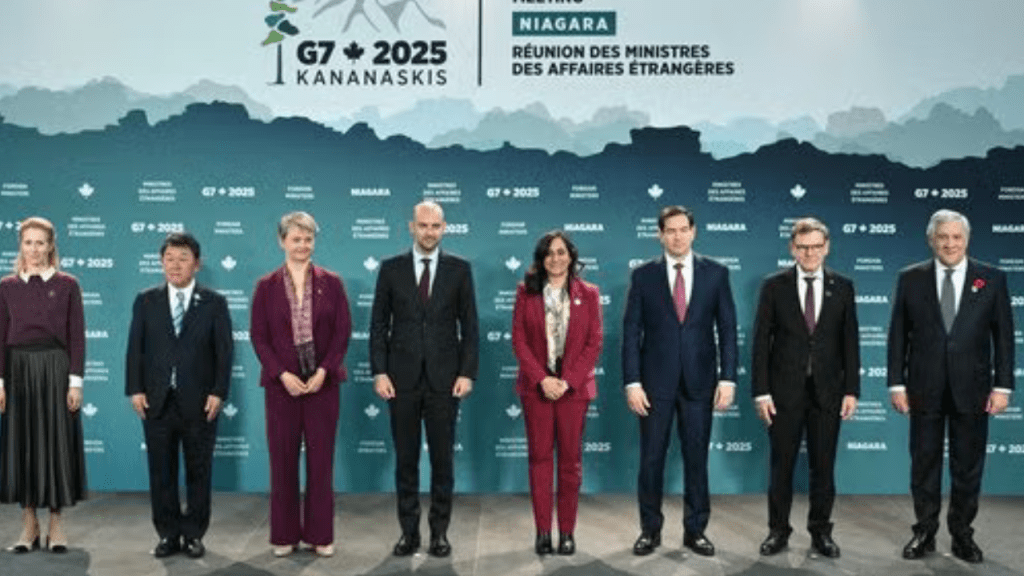
In a pivotal session held during the G7 Foreign Ministers’ Meeting, Mr. MOTEGI Toshimitsu, Minister for Foreign Affairs of Japan, joined his counterparts from the G7 nations and the High Representative of the European Union for Foreign Affairs and Security Policy for a working dinner focused on “Global Peace and Security.” The meeting commenced at 8:52 p.m. local time (10:52 a.m. on November 12 in Japan) and lasted approximately 130 minutes.
The ministers engaged in a candid exchange of views on pressing global issues, reaffirming the G7’s commitment to close communication and cooperation amid an increasingly complex security landscape. Discussions centered on three major regions:
The G7 reiterated strong support for the Comprehensive Plan to End the Gaza Conflict, proposed by U.S. President Donald J. Trump. Emphasis was placed on constructive engagement by all parties and the provision of humanitarian aid. Minister Motegi underscored Japan’s proactive role in promoting a two-state solution, pledging personnel for provisional governance and assistance for Palestinian state-building and Gaza reconstruction.
The ministers reaffirmed the importance of a free and open Indo-Pacific grounded in the rule of law. They voiced strong opposition to unilateral actions aimed at altering the status quo by force or coercion, particularly in the East China Sea, South China Sea, and Taiwan Strait. Minister Motegi condemned North Korea’s nuclear and missile programs, highlighting illicit funding sources such as cryptocurrency theft and foreign currency earnings from overseas IT workers. He also called for G7 support in resolving the longstanding abductions issue.
Ahead of further discussions with the Ukrainian Foreign Minister, the G7 emphasized the urgency of an immediate ceasefire and the pursuit of a just and lasting peace. The ministers agreed to maintain a unified approach in supporting Ukraine’s sovereignty and stability.
The session also covered developments in Latin America and Africa, with the G7 reaffirming the importance of coordinated responses to emerging challenges across these regions.
 The Bench Files
Leave a comment