
Finance Secretary Ralph G. Recto announced a major milestone in the country’s labor market, revealing that 50.1 million Filipinos were employed in August 2025, marking one of the highest employment levels ever recorded in Philippine history.
“This is proof that our economy is growing in a way that truly benefits ordinary Filipinos,” Recto said. “Our goal is not just to create jobs, but to ensure that every Filipino has the opportunity to thrive through work that is dignified, secure, and sustainable.”
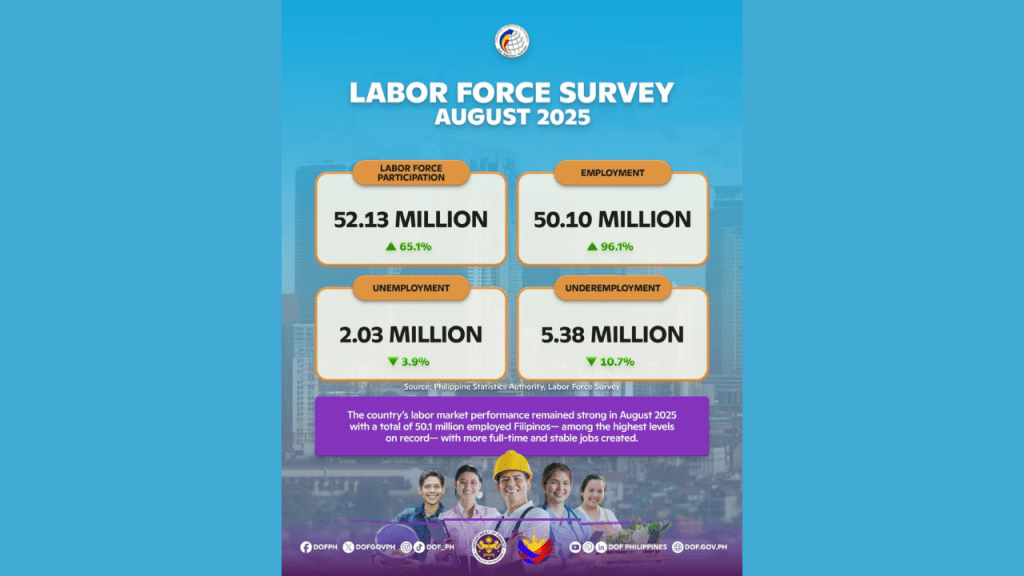
According to the Department of Finance, the country added 942,000 new jobs compared to the same period last year. The unemployment rate dropped to 3.9%, with only 2.03 million Filipinos reported as jobless. Underemployment also improved, falling to 5.4 million, indicating that more workers are now engaged in full-time and stable employment.
The surge in employment was driven by growth in key sectors such as:
– Construction (+540,000 jobs)
– Fishing and Aquaculture (+448,000)
– Administrative and Support Services (+307,000)
– Agriculture and Forestry (+300,000)
– Other Service Activities (+239,000)
Wage and salary jobs in private establishments rose by 1.5 million, now accounting for 64.4% of total employment or 32.3 million workers. Full-time employment increased by 766,000, while vulnerable employment declined by 125,000.
“This is a good sign that Filipinos’ access to decent and sustainable livelihoods is improving, paving the way for a broader middle class,” Recto added.
To sustain this momentum, the government has expanded job facilitation programs nationwide. In September, the Civil Service Commission held job fairs offering over 8,000 vacancies across 254 government agencies, SUCs, and LGUs. The Department of Labor and Employment (DOLE) also partnered with 35 schools and training centers in Eastern Visayas to strengthen school-to-work transitions.
Meanwhile, the “Handog ng Pangulo 2025” job fairs mobilized over 1,000 employers, offering nearly 100,000 local and overseas job opportunities. TESDA also launched a digital platform with Bizooku Philippines to connect certified workers with clients.
President Ferdinand R. Marcos Jr. introduced the Turismo Asenso Loan Program, which provides low-interest loans of up to ₱1 million to MSMEs in tourism-related sectors, aiming to stimulate job creation in food services, accommodations, transport, and tours.
To protect workers in non-traditional setups, the government is pushing for the Freelance Workers Protection Act (House Bill No. 2856), which seeks to ensure fair contracts, timely pay, and safeguards against abuse.
With strong numbers and proactive policies, the administration hopes to build a more inclusive and resilient labor market—one that empowers every Filipino to participate in the country’s economic growth.
 The Bench Files
Leave a comment