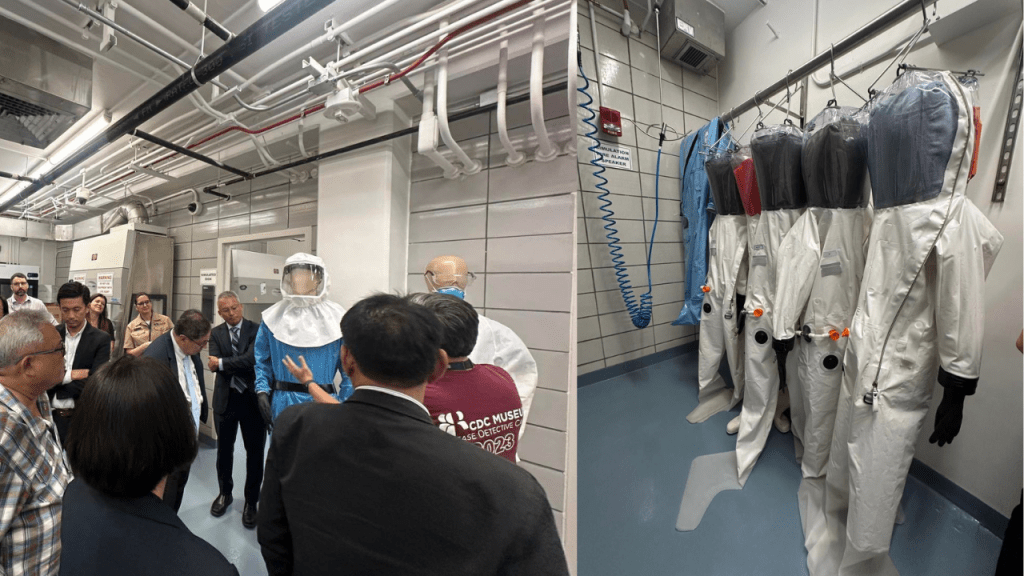
The Philippine delegation, led by the Department of Health (DOH) Secretary Teodoro J. Herbosa was immersed in biosafety levels’ specific containment controls in the Centers for Disease Control and Prevention (CDC) Laboratory Training Facility and emergency operations in the CDC Operations Center on June 25- 26, 2024, in Atlanta, Georgia.
Aside from the tour of the facilities, there was also a discussion on the requirements in laboratory practices, safety equipment, and facility construction and to provide technical guidance and insight on the CDC’s experience in establishing an emergency operations center on June 25 and 26, respectively.
The training facility featured Biosafety Level (BSL) 3 and 4 Laboratories. Biosafety levels are a set of biocontainment precautions needed when isolating biological agents in an enclosed laboratory facility, with levels ranging from the lowest biosafety level, BSL 1, to the highest, BSL 4. The emergency operations center tour, on another note, is pivotal in the plans of the DOH to build a public health operations center, in addition to its DRRM-H Emergency Operations Center.
The CDC Laboratory Training Facility tour was facilitated by Mr. Aaron Villarama, Biologist, Office of Laboratory Science, Office of Laboratory Science and Safety, Immediate Office of the Director; Dr. Anne Purfied, Associate Director for Laboratory Science, Global Health Center; Dr. Melissa Pearce, Biologist/High-containment Laboratory Manager, NCEZID; Dr. Heather Alexander, Branch Chief, International Lab Branch, Division of HIV and TB (DGHT), Global Health Center. On the other hand, the emergency centers tour was facilitated by Mr. Mark Frank, Deputy Director, Division of Emergency Operations, Office of Readiness and Response and Dr. Mark Anderson, Branch Chief, Global Public Health Emergency Branch, Division of Global Health Protection
Under the supervision of Secretary Herbosa, the team also joined the CDC experts for a two-day dialogue during the visit. Among the topics discussed were Emergency preparedness and response in the Philippines, Building the public health workforce, Sustainable digital health interventions and leveraging data for action, Vaccine-preventable diseases, Comprehensive approaches to HIV and TB prevention and response, Addressing Hepatitis and TB, anti-microbial resistance, Respiratory disease priority-setting, and Climate and public health.
The DOH and US CDC will continue to collaborate in various health programs and reforms such as improvement of surveillance and laboratories, addressing public health concerns such as HIV and vaccine preventable diseases, improvement of the FETP program, and many more. This is aligned with the Department’s Action Agenda #8, “Proteksyon sa anumang pandemiya”, which aims to strengthen the capacities of the country’s national and subnational reference laboratories, and establish linkages among laboratory networks.
 The Bench Files
Leave a comment