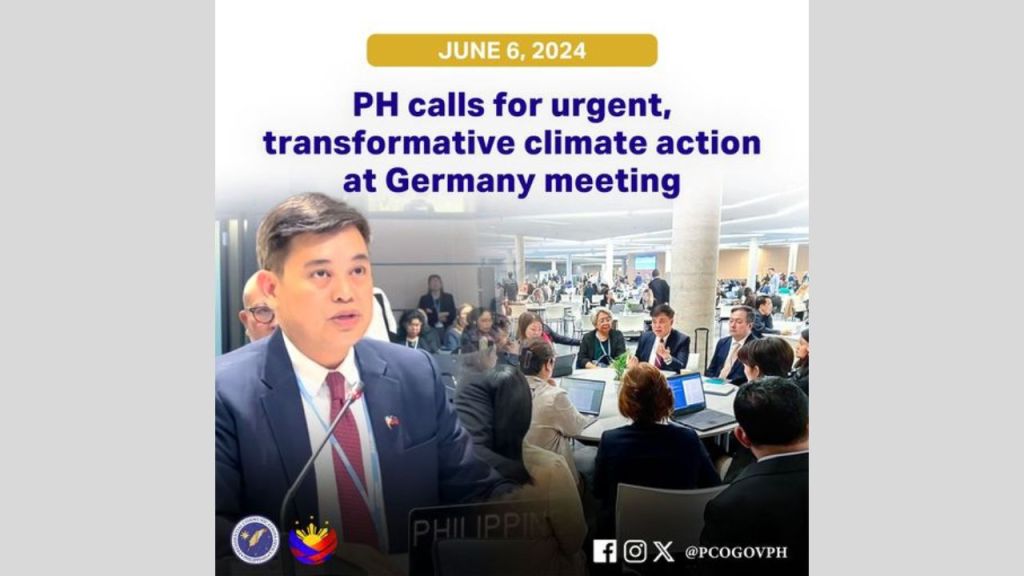
Guided by the climate goals of President Ferdinand R. Marcos’ leadership, Philippine delegates to the joint opening plenary of the 60th Sessions of the Subsidiary Body for Scientific and Technological Advice (SBSTA) and the Subsidiary Body for Implementation (SBI) in Germany have called for urgent and transformative climate action.
Speaking at the 60th Sessions of Subsidiary Bodies (SB60) of the United Nations Framework Convention on Climate Change (UNFCCC), Secretary Robert E.A. Borje, the Vice Chairperson and Executive Director of the Climate Change Commission (CCC), and co-head of Philippine delegation, emphasized the need for stronger and sustained momentum for climate action rooted in science, evidence, and indigenous and local knowledge.
Warning on the critical decade ahead, Borje called for significant progress towards enhanced resilience and low-carbon, sustainable development.
Under the leadership of President Marcos Jr., the Philippines has aligned its economic and prosperity agenda with climate change goals, making climate change integral to national policies, guiding, planning, implementation, and multi-level decision-making.
The country’s representatives at the climate gathering also urged nations to build on COP28 outcomes, including the Global Stocktake (GST-1) results, the UAE Global Climate Resilience Framework, and the operationalization of the Loss and Damage Fund.
They emphasized the urgency of advancing all agenda items, particularly the determination of a new collective quantified goal on climate finance.
The Philippines has recently completed its first National Adaptation Plan (NAP), becoming the third ASEAN country and the 56th in the world to submit such a climate adaptation roadmap.
The NAP 2023-2050 is a country-driven, collaborative effort between the Climate Change Commission (CCC) and the Department of Environment and Natural Resources (DENR).
It underscores inter-agency partnership in developing a fit-for-purpose, science and evidence-based strategic adaptation actions across various sectors threatened by the current and projected impacts of climate change.
Driven largely by domestic resources and bilateral partnerships, the Philippines is working on the NDC Implementation Plan, Just Transition Work Programme, Biennial Transparency Report, Long Term Strategy, and NDC updating.
The Philippines has been calling for a collective action to close mitigation and adaptation gaps and support the development and implementation of NAPs and NDCs by developing nations, urgently operationalize the Loss and Damage Fund, and carry out the Just Transition Work Programme to uphold human rights, create green jobs, enhance livelihoods, and develop green and blue economies.
It also wants to accelerate the provision, mobilization, and delivery of finance, technology, and capacity from developed to developing countries and ensure transformative climate action for all vulnerable populations, including indigenous peoples, local communities, women and girls, children and youth, the elderly, and differently-abled individuals.
Climate change presents a complex and multifaceted threat to the Philippines, with the 2023 World Risk Report ranking it as first among countries with the highest disaster risk exhibiting complex interactions of multiple exposures and high intensities.
According to the Philippines Country Climate and Development Report, by 2030, climate change is projected to impact 7.6 percent of the country’s total gross domestic product (GDP), amounting to PhP1.4 trillion, and rising to 13.6 percent by 2040.
Climate analytics suggest that the cost of inaction will stem primarily from infrastructure damage due to climate-induced disasters (up to PhP365 billion), productivity losses from extreme heat (up to PhP466 billion), business interruptions (up to PhP527 billion), and relocation-related costs (up to PhP8.9 billion) for communities displaced by climate events.
These adverse effects are expected to intensify by 2050, potentially reaching 18 percent to 25 percent of GDP.
Socially, climate change severely impacts the population, especially vulnerable groups, who bear the brunt of climate-induced displacement, livelihood loss, and heightened inequality.
As one of the 198 Parties to the UNFCCC, the Philippines participates in SB60 intersessional climate negotiation.
The Philippine delegation is composed of 11 agencies, including CCC, the Department of Environment and Natural Resources (DENR), Department of Foreign Affairs (DFA), Department of Energy (DOE), Department of Finance (DOF), Department of Agriculture (DA), Department of Labor and Employment (DOLE), Department of the Interior and Local Government (DILG), National Economic and Development Authority (NEDA), Presidential Communications Office (PCO), and the Philippine Information Agency (PIA).
SB60, being held in Bonn, Germany from June 3-13, 2024 provides a crucial platform for dialogue and negotiation leading up to COP29 in Baku, Azerbaijan.
 The Bench Files
Leave a comment